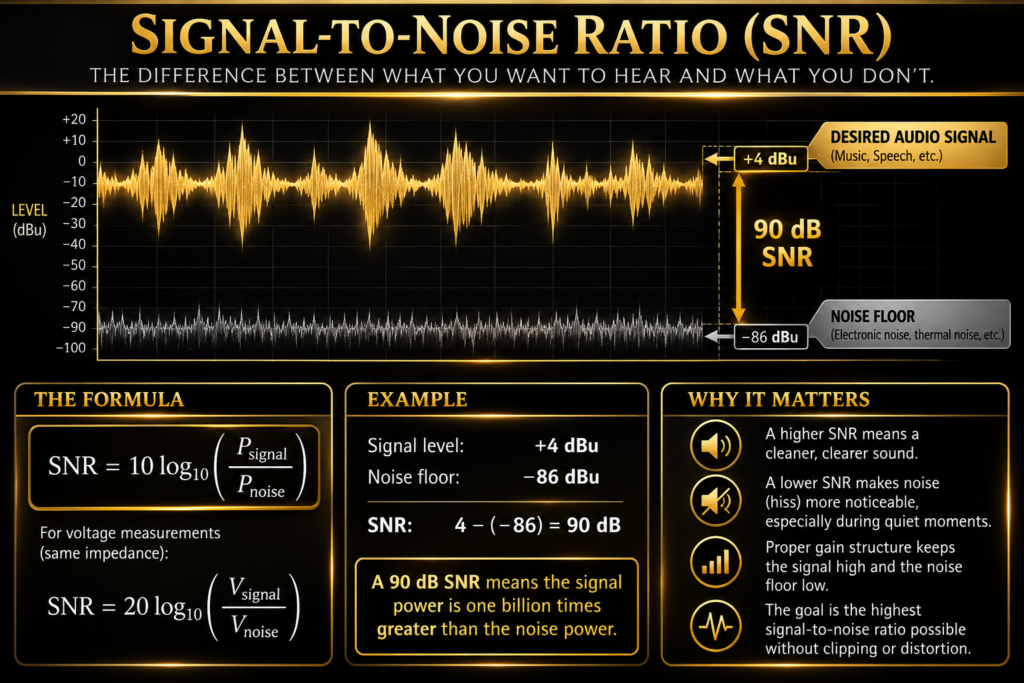
A practical technical guide to gain staging in digital mixers and powered PA systems.
This is one of the hardest things most people fail to comprehend in live audio mixing, that truly must be understood in order to have your audio sound the best it possibly can. The graphic above and the explanations below may seem complicated and you really don’t need to understand them, but you must understand the logic behind them. All of the math and all of the explanations below boil down to two simply requirements. PROPER INPUT GAIN + PROPER GAIN STAGING!
That’s it. Enjoy the read, don’t worry about the math!
- What is the noise floor? The noise floor is the level of unwanted background noise in an audio system. It may include thermal noise, analog electronic hiss, converter noise, and noise contributed by connected devices. A quiet system keeps that noise well below speech and music. The standard engineering term is signal-to-noise ratio (SNR): the ratio of useful signal power to unwanted noise power. A higher SNR is better. The inverse, noise-to-signal ratio (NSR), is better when lower.
- How SNR is calculated? SNR (dB) = 10 log10 (signal power / noise power). For RMS voltages measured across the same impedance: SNR (dB) = 20 log10 (signal voltage / noise voltage). Suppose the reference output signal is +4 dBu and the output noise level is -86 dBu. Because both are in the same units, subtract their levels: SNR = +4 – (-86) = 90 dB. A 90 dB SNR corresponds to a signal power one billion times the noise power. These numbers are illustrative, not published
specifications for a particular mixer. - Why master-fader position can matter. Consider a digital mixer feeding powered speakers. If the mixer delivers a healthy output signal and the speaker input sensitivity is set appropriately, the system can achieve the required room SPL without
unnecessarily magnifying downstream noise. Now assume the master fader is reduced by 30 dB. The wanted signal at the mixer output drops by 30dB. If the noise introduced by the mixer’s analog output circuitry after that attenuation remains
unchanged, the output SNR becomes 30 dB worse. Condition Signal Analog output noise SNR: Master near unity +4 dBu -86dBu 90dB. Master at -30dB -26dBu -86dBu 60dB. If speaker input gain is then raised to recover the same room SPL, it also amplifies that analog output noise. Raising the speaker gain does not recover the lost SNR. Important qualification: noise already present before the master fader is attenuated together with the music. Restoring the level downstream does not necessarily change the ratio between that noise and the music. Real-world results depend on where the dominant noise originates, and on the speaker’s own noise characteristics. - Does a low master fader reduce DSP precision? No. The Behringer WING uses 40-bit floating-point signal processing at 48 kHz. Moving the master fader to -30dB does not change the processing engine to fewer bits or disable DSP calculations. Floating-point processing retains numerical precision over a wide range of signal levels. However, digital audio ultimately passes through D/A conversion and analog electronics, where finite noise floors and headroom limits remain. Internal processing precision and complete-system SNR are different specifications.
- SNR, dynamic range, and headroom. Signal-to-noise ratio: difference between a specified reference signal level and the noise level. Dynamic range: span from the noise floor to the maximum usable signal under a stated distortion criterion. Headroom: margin between normal operating level and clipping. Good gain staging aims for a strong, clean signal without clipping any stage. Neither maximum speaker gain nor maximum mixer output is inherently the correct setting.
- Applying this in a church. A useful setup method is to start with the powered-speaker gains low, establish sensible input and bus levels, place the mixer master near unity, play a representative reference signal, and gradually adjust the speaker input sensitivity to achieve the intended SPL. Verify the levels at multiple seating positions and leave adequate headroom for musical peaks. A quieter PA matters especially during spoken prayers, sermon pauses, and transitions between worship songs, when hiss is easiest to hear. Room SPL, coverage, feedback margin, and speech intelligibility must also be evaluated independently: changing gain distribution alone does not cure poor speaker aiming or acoustic feedback. Bottom line: Keep the wanted signal comfortably above the noise floor, preserve headroom, and set downstream sensitivity for the required acoustic level. Unity is a useful operating reference, not a requirement for full floating-point DSP precision.