Does Your Sound Engineer Know the Local Noise Laws?
Running Live Sound Is More Than Turning Up the Volume
Whether you are providing sound for a concert, festival, wedding, corporate event, private party, community event, outdoor gathering, nightclub, theater production, or any other live event, there is something every professional sound engineer should understand. Knowing how to operate a mixing console is not enough. You also need to understand the noise regulations that apply to the location where you are working, and this has absolutely nothing to do with whether the event is being held at a church.
Every county, city, and town can have its own requirements concerning amplified sound, permissible sound levels, hours of operation, property-line measurements, permits, variances, and noise disturbances. In some jurisdictions, the rules may be based on specific decibel limits. In others, the ordinance may consider factors such as the time of day, zoning, duration of the noise, whether the sound crosses a property boundary, or whether the sound is considered unreasonable or disturbing. (Arlington County)
Why Should a Sound Engineer Care?
Because you are the person controlling the sound system. When you are behind the console, you control the level going to the PA system. You control the overall output, subwoofer level, microphone levels, playback levels, monitor levels, and other aspects of the sound system. That means you should know what the local requirements are before you turn on the PA. The event promoter, venue owner, event organizer, or property owner may ultimately be responsible for obtaining permits and complying with local requirements. However, that does not mean the sound engineer should ignore the regulations. A professional engineer should know the limitations of the venue and the jurisdiction and should be prepared to operate the system accordingly.
Indoor Events Can Have Noise Regulations Too
Many people assume noise ordinances only apply to outdoor concerts. That is not necessarily true. Depending on the jurisdiction, amplified sound inside a building can still become a noise issue if it can be heard outside the property, affects neighboring properties, or violates a local ordinance. For example, Arlington County, Virginia specifically addresses loud music and live entertainment under its noise-control requirements, including circumstances involving indoor music. (Arlington County) The fact that the speakers are inside a building does not automatically mean the sound is exempt from local noise regulations.
Outdoor Events Require Even More Planning
Outdoor sound presents an entirely different challenge. There may be homes, businesses, roads, parks, neighborhoods, and other properties surrounding the event. Sound does not stop at the property line. A system that sounds perfectly reasonable at FOH may be considerably louder at another location on the property—or may be creating a noise problem several hundred feet away. Some jurisdictions establish maximum sound levels at specific measurement locations. Others may prohibit amplified sound during certain hours or require a noise permit or variance for particular events. (AlexandriaVA.Gov) That means the sound engineer needs to understand where the sound level is supposed to be measured, not simply how loud the PA is at the mixing position.
“But Nobody Told Me About the Ordinance”
That is exactly why you should ask questions before the event begins. Before accepting or operating a live sound job, consider asking:
- What city, town, or county is the event located in?
- What are the local noise regulations?
- Are there specific decibel limits?
- Where are those limits measured?
- Are there different limits during daytime and nighttime hours?
- Is there a required cutoff time for amplified sound?
- Does the venue have a noise permit?
- Does the event require a noise variance?
- Are there restrictions on outdoor amplified sound?
- Are there neighboring residences or businesses that could be affected?
- Who is responsible for monitoring sound levels?
- What happens if a noise complaint is received?
- Does the venue have its own sound-level requirements in addition to local law?
These are not unreasonable questions, they are part of professional event production.
Don’t Confuse Local Noise Laws With OSHA
There is another important distinction that professional sound engineers should understand. Local noise ordinances and occupational noise regulations are not the same thing. A local noise ordinance generally deals with noise affecting the surrounding community, properties, businesses, or public spaces. OSHA’s occupational noise requirements, on the other hand, address employee exposure to potentially hazardous workplace noise. OSHA states that employers in covered general-industry workplaces must implement a hearing conservation program when employee noise exposure reaches an 85 dBA 8-hour time-weighted average. (OSHA)
In other words, the law protecting the neighborhood from excessive noise is not necessarily the same law protecting workers from excessive noise exposure. A professional sound engineer should understand the difference.
Your Sound Meter Should Be Part of Your Toolkit
A professional sound engineer should not have to guess how loud the system is. A properly used sound-level meter can provide objective information about what is happening in the sound field. And remember, the level at the mixing console is not necessarily the level that matters to the local ordinance. If a jurisdiction specifies that sound is measured at a property line, that is where the measurement requirement may apply, not simply at FOH. You need to understand the ordinance before deciding where and how to monitor the system.
Protect Yourself and Your Client
Knowing the local noise regulations can help protect everyone involved:
The sound engineer.
The event organizer.
The venue.
The property owner.
The performers.
The audience.
And the surrounding community.
It can also prevent an otherwise successful event from becoming a problem because the sound system exceeded a local requirement. A noise complaint can potentially result in warnings, enforcement action, fines, permit problems, or the interruption of an event, depending on the jurisdiction and circumstances. Some local governments expressly provide for penalties and enforcement of noise violations. (Arlington County)
Professional Sound Engineers Need to Know More Than Audio
Being a professional sound engineer isn’t just about knowing your console. It’s about understanding the entire production environment. You should know your:
- Console.
- PA system.
- Signal flow.
- Gain structure.
- System processing.
- Speaker coverage.
- Acoustics.
- Sound levels.
- Safety requirements.
- Venue requirements.
- And the laws that apply to the event.
Before you show up at a venue with thousands of watts of amplification, know what the local government allows you to do with it.
Don’t Wait Until the Police Show Up to Find Out.
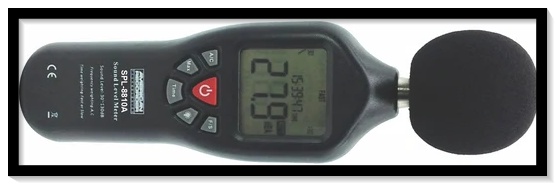
Know the Noise Ordinance, Know the Permits, Know the Measurement Requirements, Know the Time Restrictions and Know Your Responsibility. Because being a professional sound engineer means more than making an event sound great. It means knowing how to operate that sound system legally, safely, and responsibly. The meter below works great for measuring Sound Pressure Levels and will meet most criteria for local and state laws. it’s around $99. You can click on it to go to their website.